Saturday, July 20, 2013


Friday, July 19, 2013
Wintergirls
WINTERGIRLS
(Picture from http://lovelyreader.blogspot.com/2011/05/wintergirls-review.html)
Trigger warning: Eating disorders
Whoa. An actual review. Crazy.
So, strange thing about this book. There was no 'getting from point A to point B'. Honestly, the plot was basically just an important snippet of life for Lia. I thought that was interesting.
Onto the actual book.
I want to say I loved this book. I mean, I really wanted to love it. I bet I could have loved it. But reading it was like swimming through corn syrup instead of water.
It was like reading a poem, minus the breaks that make it sound like a real poem. It was thick with metaphors and similes, and while they sometimes improved the mental picture, a lot of the time it made the writing muddled and confusing. It was kind of like purple prose.
The character, however, was relatable (well, as long as you're a teenaged girl, so sorry guys) and well written. I'll begrudgingly accept that some of the things she said (the book is written in the first person), which made it sound more poetic and purple, actually kind of made sense. Made a lot of sense. Whatever.
A couple of things are mentioned at one point and then forgotten for the rest of the book. Lia's little sister, Emma, has two cats, which disappear after one mention. The Cupcake Scene (as it shall be addressed) happens, and then is promptly forgotten, even though you'd think Lia would remember it and that it would be important in her records at New Seasons (a mental recovery place) later. Maybe, 'hey, look, she actually wants to/can eat, she just doesn't'. Something like that is a tad important.
The dialogue was well thought out and believable. People, unlike some stories I've read, actually spoke like people, not Shakespearean characters. So, despite the way that it was written, it's not like normal people spoke like poets.
On the other hand, a lot of parts of this book were confusing. I'm not sure if that's the metaphors and similes talking, but some parts of the book make me wonder if Lia was a psycho, because they just don't make sense. It's like the author would occasionally forget that this was supposedly a contemporary book. Trust me, if you read it, you'll know what I mean.
About halfway through the book, it actually starts sounding like a true narrative, and then it slowly falls back into the poetic, purple style. Just thought that was interesting.
Despite my complaining, this was a good book. The dialogue and emotions were both very believable, and the plot (or whatever it is) was good. So... Yeah. Also, if you like symbolism, you'll probably love this. I don't love symbolism. It's my personal opinion that probably made this book seem worse to me.
Monday, July 15, 2013
A Few Things to Look Out For
So, this is just another complaint. I promise we'll have actual reviews soon. I'm almost done with about three different books. I'll get to it.
This is about the many follies you may, just may, want to avoid while writing.
1. Every teen smokes and drinks
Listen up, because this is probably why teens are looked at so badly. Not because we all go on big drinking binges and scream at our parents, but because that's what we're advertised to do.
For some reason, YA authors are convinced that every teens drinks and/or smokes pot/crack (do you smoke that?)/cigarettes. Yes, in the real world, some people do that. Heck, I KNOW people who do that. There's a girl in the grade above me that constantly brags about stealing vodka and beer and tequila and (insert any other alcoholic beverage here). She also complains about having headaches all the time and also brings up her puking habits too, interestingly. But not everyone is her.
A lot of books talk about teens drinking very casually. No mention of straight edge people (high five to all my straight edgers out there), people who don't want to, Muslims, Mormons, and kids who don't like the idea of the possibility of a multi-thousand dollar fine over their head.
In some settings, this is kind of understandable (thank you to D.H. Scott on Figment for pointing this out to me). Maybe it's a run down, crime filled place. Or maybe something traumatic happened and character X uses alcohol or drugs as a getaway. But this is rarely the case in YA.
2. Textbook minorities
This one will continue sarcastically. If I got all my information from YA, this is what I'd "know". Please do not take offense, as this is sarcasm,
~ If a guy is gay, then he is destined to act like a whiny little girl that calls everyone darling, honey, or some variation of that type of thing. He is overly concerned with fashion and hangs out with more girls that guys. He is extremely flamboyant and is horrible at anything athletic. Always.
~ If there's a lesbian, she is butch and macho and sarcastic and arrogant. She is never shown in an actual relationship.
~ If you're Latina or Latino, you are from Mexico. Only Mexico. Central and South America are hoaxes created by the government to keep us in line.
~ If you are African American, you have two choices. As a guy, you are butch and strong, you're probably on the football/basketball team. If you're a girl, you're sassy and probably give a bunch of advice on dating.
~ Native Americans are super wise, have no knowledge of contractions, and have some affinity with nature. Defining what tribe/community they are from is unnecessary. Unnecessary, I tell you!
~ Asians are a rare breed of extremely intelligent superhumans. Their lives revolve around being goody-goodies and getting A+s.
~ West/East Pacific Islanders don't exist. Guam is a lie.
~ Atheists are only ever atheists because something bad happened and they decided the world was too cruel and God couldn't exist, boo hooooo. Evolution, the Big Bang theory, and all other ways it's possible we don't need a god don't exist.
~ Jews are just Christians with Bat Mitzvahs and Bar Mitzvahs and celebrate Hanukkah instead of Christmas, right?
~ Muslims don't exist, silly. And is they do happen to appear, they say 'Allah' instead of 'God', though when speaking English, that is the name He is addressed by.
~ Buddhism and Hinduism are only practiced in Asia. Fiction is an Abrahamic-only club.
Now, before I punch a wall, onto...
3. Example characters
I didn't know what to call these guys, but here's basically how it works: if a character is not perfect/is a minority, they are used purely as a way for the author to say "Look! I'm okay with overweight/pimply/minority/etc. people! I included them in my story as minor, personality-less characters!" Usually has some textbook minorities in there.
Can also lead to a Gaysop's fable, in which we learn 'gays are people too!' in a really unnervingly in-your-face fashion. Because we didn't know that they are. Because all teenagers are homophobes. All of them, even the LGBTQ ones.
Or we can learn that you don't have to be beautiful (like the MC) to be a good person. Actually, you do. Because if you're fat, you're whiny, if you're not athletic, you have no social life. Because...
4. Teens only love each other based on looks
If you don't have dazzling/piercing/sparkling/deep/[poetic adjective] green eyes and smokn' hot abs, you are nothing. NOTHING.
Onto the more serious bit, these kind of romances frustrate me to no end. These are the reasons why I usually complain about romances in YA. Do the authors seriously think that the only reason we need to love is good looks? That the only kind of love is love at first sight? What about personality, friendship based relationships? The way love is portrayed in most YAs is unrealistic and grossly exaggerated.
Or maybe the descriptions are because of...
5. Minor teen dramas are blown up
This really didn't occur to me until a book I read about a month ago (I won't mention the title, since this is what I hate, and no need to be a jerk). I know high school dramas. Mean girls, gossip, romantic troubles, but YA authors don't seem to remember how it was back in the old days. Or maybe Nowhere, USA, just doesn't have enough people for it to be too big. Either way, a lot of small things go huge in YA.
Break ups- When I finally entered the great world of romance (read: my friends did, I watched), I was surprised how easy break ups could be. No screaming, no crying, no ice cream chugging, just the general rule of hush, hush when it came to the ex's name. And even that would be over in a month. Usually, we forget him pretty soon. The name drifts off to meaninglessness.
It's not too bad for guys, either, from what I can tell. From my observations of guys in school and my cousin at one point, it's no angsty, "oh, dear X" fit.
If someone is going to break up, it usually gets obvious. By the time they break up, you've probably steeled yourself because they've been giving you the cold shoulder. Or maybe we're just good at keeping quiet. Maybe we shouldn't listen to me, being a partner-less, never partnered person. You can listen to me about the next one, though.
Rumors- I have had more rumors than I can count swirl around me. It's natural. Usually, they're more laugh-worthy than anything and dissipate pretty quickly. We may not be tiny adults, but we're pretty darn good at sniffing out a lie. We've been raised in a world with not always true information (the Internet, each other), we know when to be skeptical and do some extra poking around. And since rumors are usually lies, they don't usually catch on unless they're really good.
Who loves who- You will not become a social pariah by dating X, X, or X, unless they're someone else's, in which a case you're doomed. Saying you aren't, though, we don't care. It's usually a quick laugh if you don't think it'll work, and then acceptance if it does. Or, if you're a friend or sibling, secretly plotting to get rid of your friend's/sibling's partner because they don't give you enough attention anymore.
New kid- I was a newbie to my school when I was in second grade, so I'm not sure what the feeling would be in my current grade, but I'll make some guesses based on what I've seen.
* Everyone tries to be your friend. They want another friend, and you're a blank slate.
* People are concerned with what you do and wear. First impressions really do count. The new girl that our class got last year was at first accepted and soon rejected because of her tendency to wear skin-tight, skimpy, barely-allowed-by-dress-code clothes. So I imagine clothes would be a major concern as the newbie.
* Usually newbies are sucked in by the eeeeeevviiiil popular crowd. How do they remain in power? They get a lot of people. How do they get new people? They warm up to the new kids.
* We get over your existence within a month. That's right. Even in my hometown of Nowhere, getting a new kid isn't that big. It's nice for the first couple days, but quickly you'll be brought into the flow. In a bigger town? I bet it would take a week.
The Popular Kids- Call them what you like, the Peacock girls (that name makes me laugh), the Populars, the Pops, we had the Sis Crew, they're the in your face popular kids. Except they usually aren't too in your face.
Yeah, they can be jerks. Huge jerks. Want-to-punch-them-in-the-face jerks. But they're actually a lot like bears. As long as you avoid them, they avoid you. (Now I'm thinking of a grizzly bear in hoop earrings and a miniskirt. It's kind of odd.)
No, sorry to burst your bubble, for the most part, they don't insult random people just for fun. If they did, they wouldn't be popular. Maybe they should be called the Rich Kids if they're doing that.
Yeah. Sorry. But I think knowing will make you a better author.
6. Teens think adults are idiots
Riiiiiight. We probably live with an adult or two. It would kind of suck if we thought they were completely ignorant/oblivious.
You see, from what I can tell, I don't know anyone who thinks their parent(s)/guardian(s) is/are complete morons. A bit bad with technology sometimes, yeah, but you'd be surprised how often adults actually understand teen dramas.
Here's some problems that I think really do need to be addressed.
- Listen. Seriously. I understand, we're not "old enough" to understand complex problems such as politics and human rights and... Oh, wait. Some of us are.
We understand how the world works better than you may think. Otherwise programs like Future Problem Solvers wouldn't exist. But people disregard our opinion purely based on age. It wouldn't matter if we wrote a scholar-level persuasive essay on our views. It wouldn't matter. That's what I love about the Internet. You can talk about your views without being disregarded based on age, as long as you don't say how old you are.
- Needing to say the right thing all. The. Time. At least at my age, everyone is hypercritical about what you say. Say one thing wrong, and, bam, you lose everyone's trust. Without knowing why. Because people think we're old enough to always need to be right, without realizing we're just getting out of random thinking and just starting to figure out what we are and aren't allowed to say.
Be mature, don't bring up mature topics, stay young, don't act so immature, be responsible, we can't trust you.
- Be uniquely conformed. It's always stressed on me, and from what I can tell, my friends, that we need to be individuals. Individuals, to the standards of everyone else. Because the reason you're bullied is because you're so flamboyant. No, you lost your personality. No, stop being so weird. Be yourself, don't conform, conform, hush, hush.
So it's not "you just don't get me" all the time. There is so much more to it.
7. Txt Spk
... Not all of us talk like we're in a chatroom, and I'd prefer you didn't write like that. Because this is how it feels when you want to write your story "like a teen would":
OMG! It's like, whoa, this is a totally STUUPPPIIIIDDD way of writing. LOL! Omg, I can't even tell what it means, which totes sucks. Ugh, I feel stupid just reading this!
... No. No no no. Do NOT patronize me. All the capitalization instead of italicization, the acronyms, it's, OMG! HORRIBLE!
You know what also applies? Seeing a hot guy (*grumble* It's always a guy.) and saying something along the lines of "Time to drool", "drool", "drroooooooolll", or basically saying drool at all. Or saying parents are so stoooopiiiid in your book, as discussed above. It's not relatable, it's weird.
Don't patronize me.
8. All teens are hateful
Kiddies, not all of us are racist. Not all of us are homophobic. Not any more than adults, at least.
My school has two options when it comes to race- white, or Filipino. Did we go crazy when a kid from the Dominican Republic joined us? No. Because we don't care. Our life isn't based on thinking up racist jokes (though I do know a plethora of white jokes).
Okay, my school isn't a great example for anti-homophobia, considering I have classmates who use "gay" as an insult (as a reply, I always say "Ugh, you're so straight." It shuts them up.), but GSAs? Remember those? There are plenty of schools with them because the kids accept and join them.
And while my town also isn't a great example for religious diversity (the only type of building we have more of than churches is houses), not everywhere is like that. Unless you're in a really conservative town, you should be pretty good. Younger grades are more freakishly concerned with who you are because they only know how to parrot what their parent(s) say(s). At around tenth grade, things get better. People think for themselves. People will even change religions. So, not all of us are like that. Get over it.
A dandy little rant I had there. Now, I'll get to reviewing.
~Corinne
Friday, July 12, 2013
The Reviewing Dictionary
I use big words. Get over it.
Beige [prose] /adj/- Emotionless, boring text that makes me want to beat my head against the wall.
Ex. "Oh no," I said as I ran from the tornado.
Purple [prose] /adj/- Over-descriptive, usually hard to understand text with lots of metaphors and similies that makes me want to beat my head against the wall.
Ex. His golden orbs pierced my heart, the feeling as sharp as wolf teeth.
(Translation: He had piercing yellow eyes.)
Spoiler /noun/- Saying something that will happen later in the book/series that ruins the surprise or emotions.
Ex. Spoiler Alert! Dumbledore dies in the sixth book!
MC /noun/- The main character whom the book follows.
Ex. In the Percy Jackson series, Percy Jackson is the MC.
Dead Pace /noun/- A really slow, hard to keep up with pace where there are long stretches of time between important things happening.
Ex. Despite being a really popular book, 1984, by George Orwell, had a Dead Pace to me.
Mary Sue /noun/- An impossibly (and annoyingly) perfect character that usually messes up the book.
Ex. Ruby Diamond Kawaii-chun was a bit of a Mary Sue.
Can be shortened to 'Sue'. See litmus test at http://www.springhole.net/writing/marysue.htm
The Love Interest /noun/- The name of any character the MC is interested in.
Ex. I liked Rich until he became The Love Interest.
Gutpuncher /noun/- A story written entirely for the purpose to mess with your emotions.
Ex. Old Yeller was a Gutpuncher.
Crack fic /noun/- A story with a plot that makes it sound like the author was on crack (could be good or bad).
Ex. Going Bovine and Far, Far Away. Both are good ones.
Death fic /noun/- 1. A story about death.
2. A story in which many people die.
Ex. The story I just read had so many people die, it was a death fic.
Faaaabulous /adj/- A drawn out 'fabulous'.
Ex. The book I read was faaaabulous.
Can have more or less 'a's. Almost always paired with 'dahling'.
Dahling /noun/- The new name of the reader, author, or anyone I am addressing. Check context.
Ex. Fabulous, dahling.
AghstupidBritishbooks /?/- The book I am reading is from some part of Great Britain, and I, from Mediocre America, keep on getting messed up with the terminology or use of apostrophes instead of quotation marks.
Ex. AghstupidBritishbooks, why do they keep calling the period a full-stop?
Genres-
YA- Young Adult- For people eighteen or younger
Paranormal- Supernatural- Based on or with creatures from mythology or folk tales. Can include (but is not limited to) angels, demons, ghosts, possessions, werewolves, vampires, chupacabras, yeti, and/or Bigfoot.
Science Fiction- Based in the future, or having aliens or robots as a main plot device.
Dystopian- A subset of Science Fiction. Based in the future with some kind of corrupt government or otherwise messed up world.
Contemporary- Set in the real world with humans, animals, plants, fungi, protists, and any and all type of amoeba as the only living things included in it.
Fantasy- You'll know it when you see it. Usually has dragons somewhere in there.
Romance- Icky lovey-dovey stuff.
Mystery- I think you know.
Historical- Based in the past.
Thursday, June 27, 2013
Far, Far Away
Far, Far Away
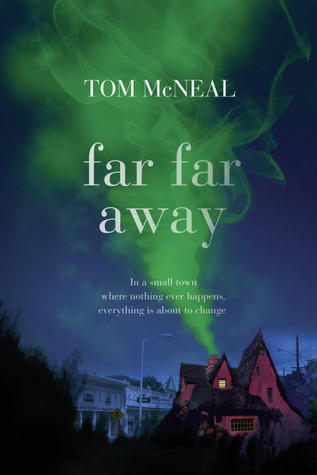
(image from its Goodreads page)
Tom McNeal.
So. Instead I chose to use an aspects format, which I'll use for stories like this.
Jeremy Johnson Johnson has been considered strange for almost all of his life. In the town of Never Better, he lives with his father and is usually too engrossed with studying to really make friends. Well, except one- the ancient ghost of Jacob Grimm.
Then Ginger Boultinghouse comes along and becomes a fast friend of Jeremy's. She falls in love with him with a bite of an enchanted Prince Cake, a town specialty made by the baker Sten Blix.
But the house Jeremy lives in will soon be foreclosed, and Ginger takes it as her duty to save him.
Plot: This is definitely going with Going Bovine in the list of stories that, when you read the description, you laugh and call it crack fiction. I don't care if crack fic is a fan fiction term. I do what I want.
Anyhow, despite how utterly bizarre the idea was, the product of it was amazing. Everything made sense and had a kind of whimsical (and, later in the book, very, very dark) feel to it. It was fun to read and not as hard to understand as my description makes it sound.
Characters: This is the point where I usually have something to gripe about. I like complaining. And right now the only thing I can complain about is the fact that I have nothing to complain about.
Jacob Grimm- In an interesting twist on perspective, this guy is our narrator. Logically, since he's the MC, Jeremy should be, or maybe it would just be third person. It definitely wasn't bad this way though. Okay. Onto the actual character.
I usually despise famous past figures being parts of fiction books. I don't know why, I just do. But I'll have to excuse this one, because the personality of Jacob (it's pronounced Yah-cub, by the way) Grimm is, from what I know (near nothing), the same as the guy that never found love but liked writing about girls getting pregnant and others dying horrible deaths. Yeah, nice guy.
I've got to say, his character really developed over the story. I loved how he changed from a nagging ghost to the reader's best friend. And makes you cry. And laugh. And cry. And want to punch him in the face. And want to hug him. He felt very real, to me at least.
Jeremy Johnson Johnson- He is our MC. He's pretty much a textbook nerd/loner, which was kind of disappointing, but made up for it by being a realistic and interesting nerd/loner. Though he didn't develop as much as Jacob, he continued to interest me. By the end of the story, any emotion he's experiencing, you are too.
Ginger Boultinghouse- Though this character was by no means bad, she was my least favorite character. She was energetic and friendly, but didn't develop as much as I hoped through the story. Nyeh.
Style: I liked this style a lot. It wasn't beige or purple, which, trust me, is a pretty big plus in YA paranormal (what this was classified as). It kept me interested throughout the story.
Sorry for the short review. I might update this later. Guh'bye.
~Corinne
Monday, June 17, 2013
Diamond Willow
Diamond Willow

(image from http://us.macmillan.com/diamondwillow/HelenFrost)
Helen Frost
I want to clear this first: this book is for much younger people than our average. Oh well, boo hoo.
So, we start this book learning a bit about Willow, our main character. As the description says, she's a junior dog musher ( NOT an easy job, by the way). Not an Iditarod junkie or anything, she just likes to work with the dogs her father owns. The description is pretty vanilla, it's basically what I'd expect for the age. Brown hair, brown eyes, plain in all ways. I think there could have been at least something to make her stand out. Not necessarily, though.
We go on to learn that Willow wants to go on a trip to her grandparents, who are native Alaskan and rather awesome. Just putting that out there. After a bit of convincing, her parents let her go.
Willow picks her dogs, a few of her favorites. Some part of me wondered why she needed four (at least, I think it was four) dogs. It's a long journey, but how heavy can this girl possibly be? A hundred pounds? How much supplies are in that sled? Twenty pounds at most. Never mind, I just think three might be a bit better.
Anyhow, the grandparents just act cool, do stuff, and eventually sen Willow and her team on their way with some smoked salmon. Sounds about right.
From this point on are spoilers. Be warned.
It's snowing pretty hard, but Willow just says "Eff you, weather." ... Well, not in those words, but whatever. When coming around a blind curve, they hit a fallen tree, and Willow's best dog, Roxy, gets hurt. Badly. Her eyes are stabbed by some kind of stick or something (I don't believe the book ever says, which I wish it did). Her eyes are bleeding horribly, and we get a nice, somewhat disgusting description. I liked how well it was described, though. It wasn't too graphic or too simple. Good on ya', Ms. Frost.
Turns out, out of those twenty pounds of supplies I assumed she had, there was no first aid kit. Instead of saying "Psssh, I'm the main character, I'll stay calm.", she shows emotion! Fabulous! She scared, worried, hoping her temporary solution of using her shirt (instead of ripping off a piece of it, which is much harder than writers apparently think) will work for the remaining few miles. With three dogs, a much more logical number.
Her parents react two ways. Her mother is more worried about the giant bruise on Willow's leg. Her father seems more worried about Roxy. Willow is scared he'll hate her for it. I'm sure we all know that feeling, when we made a horrible mistake and become sick with anxiety and guilt. There could have been a bit more showing instead of telling in how she felt, but this is a younger audience it's being targeted at (8+).
Well, Willow heals pretty fast (though she is still a bit sore) and goes back to school, where we meet her best and only friend or the first time. Kaylie (I'm taking a wild stab at the spelling) is the perfect girl, complete with perfect grades and having never missed a day of school. I'm glad she was the friend, not the MC. As we know from my recent complaint average-in-every-way-but-school characters bother me (Willow has average grades to go with her averageness).
Anyhow, life goes on. Then, after a POV switch I'll explain with he formatting, Willow finds a note saying that Roxy is to be euthanized now that he is in pain and is blind. Forever. Prepare for the mini-rant.
So, why did Willow go so insane about the euthanizing? I understand some tears and such, but she wasn't using any kind of reasoning I'd ever heard from a twelve-year-old. I expected "My dog! I love her so much, why oh why?!", which is pretty realistic for us young folks. Instead, we get "How do THEY know it's merciful? They can't ask her! What if she'll die in pain?!" Not what I hoped for. First off, it's mouth piecing, and second, it's a bit too much from a tween.
Okay. Sorry.
Willow devises a scheme to save Roxy. She will bring her to her grandparents house, where hopefully they can take her in with their other dogs (who we never see and are given no description). Kaylie is dragged into this because someone needs to hold Roxy to the sled so she doesn't jump or fall off. Kaylie has an (understandable) panic attack, but agrees reluctantly.
In near white-out conditions, they set off with three dogs, two humans, and one dog who cannot do anything. Now this number is ILlogical, because that's an extra two-fifty odd pounds added on. I will calculate until this works.
They get lost, but find a clearing to sleep in. With the smoked salmon and other foods Willow grabbed at home, they eat and sleep. In the morning, they set off again.
Eventually they are found by Kaylie's not-secret admirer, but only Kaylie goes home. Now that the weight amount is somewhat more logical, Willow continues on to her grandparent's house. Somewhere around that time Willow's frantic parents and less frantic little sister find her. They end up discussing all of this at the grandparents' house. Willow is neither speaker sternly to or given a punishment, though this scenario justifies both.
Even bigger spoiler alert.
Willow is told about how she had a twin. Named Diamond (which explains the double name). And the place that Willow and Kaylie slept for the night? It was where they scattered Diamond's ashes. Does this freak out Willow? Nope. I'm just saying, but I would have a heart attack if I heard that.
Roxy is saved, end of story that I will tell you (I won't spoil everything).
Okay, the formatting. I feel the need the explain it. Most of it is in diamond poems, but POV will switch occasionally, and it will be in plain text. The narrator is announced. I'd like to mention that an Athabaskan belief I that when someone dies, their spirit is put into an animal. It might not make sense now, but you'll be glad for it.
I liked the book, it managed to make me cry (in a good way), I'd recommend it.
Had a couple issues with this, had to repost. Sorry.
Sunday, June 16, 2013
Never to Sleep
NEVER TO SLEEP

RACHEL VINCENT
(Pic from http://stuffyoungpeopleread.blogspot.com/2012/01/never-to-sleep-rachel-vincent.html)
Well, I've been a bit lacking when it comes to reviews, mostly because I've been doing a lot of rereading of books I've already reviewed.(Pic from http://stuffyoungpeopleread.blogspot.com/2012/01/never-to-sleep-rachel-vincent.html)
This is a novella, not a novel, but boo hoo..
Onto the review.
Sophie has a cousin (Kaylee, because Thoth forbid there's a spelling I recognize) who is certifiably crazy. It's hard to tell, to Sophie, at least, if she's genuinely nuts or if she's faking it for attention, though. Either way, Kaylee is ruining Sophie's high school reputation as dance and drama queen.
Then the handsome stranger I've gotten so used to shows up and accidental hits her with a door. Very romantic.
Blah blah blah, they hit it off pretty quick and are somehow dragged into the Netherworld, an evil parallel of our more familiar earth.
So, the plot seems pretty standard. I've read plenty of alternate-reality fics. How it was executed, though, is the beautiful part. It had your usual escape plot, but it somehow avoided your usual cliches, such as alternate love interest and thinking about staying. Plus, there are evil carnivorous plants that liquefy your organs and are everywhere. It was 'everything can kill you' played straight.
There were monsters (only two were really described, though), reapers, X, X, and X. You know. Also standard. I was still more interested in the evil plants. Little Shop of Horrors was even mentioned. Woo hoo for shout-outs!
*Cough* Uh, onto the characters.
We shall start with Kaylee, our local crazy. And that is all she is ever really described as. Seriously. She had absolutely no personality beyond 'crazy'. I know she wasn't too important, but I think she deserved a little more than that.
Then there was Peyton, your usual popular girl. Also her simple personality. I've already complained about that kind of thing, I won't waste energy explaining again. It's in my rant about characters I'm tired of.
Onto Luca, Mr. Lovey-Dovey-Interesty-Winteresty. I am notorious for hating love interests. Maybe because they usually mess up the MC for me somehow. More on how he didn't later. Anyhow, he actually seemed like a realistic human being, who makes realistic human mistakes. I was basically cheering when he hit Sophie in the face with a door and panicked, because, hey, I'd panic too. He wasn't described as 100% perfect besides his abs. I really, really got tired of how much his chest was described, and how Sophie was for a moment willing to risk their lives so he wouldn't put his shirt on. No. Just no.
Lastly, Sophie. I don't think she was written badly, exactly, I just really didn't like her personality. She came off as extremely shallow and was more worried about her designer jeans than escaping. She didn't really develop that much through the story, which was disappointing. It's pretty sad when I like the love interest more than the main character.This, to people who have read my reviews before know, is big: I accepted the romance. It wasn't annoying and Sophie stayed as an action girl instead of turning into a damsel in distress, and could figure out things by herself with or without Luca. There was a surplus of kissing towards the end, though.
The descriptions were very clear and really helped the story. There were a couple plot points that didn't seem to materialize (Sophie is being kept because she is of use to a hellion, but it's never said why or even hinted at), but it was definitely worth reading.
Subscribe to:
Posts (Atom)