Thursday, February 13, 2014

Whatever that means

Some dumb descriptions I've seen and want to compile into a sort-of complaint. Not going to say what book they're from because I'm a good person. But I'll still put a little blurb about it afterwards.

"... he had abs of chiseled smoke." What? No, seriously, what? Not that it was a good story anyway (focused on a daughter of Artemis, who I'd like to point out is an eternal virgin), but that really takes the cake. And how do you chisel smoke, anyway? Isn't it a gas? Unless, of course, you managed to freeze it and then chisel it, but that's complicated and weird. And that would mean his abs were gray, wouldn't it? Creeeeeppyyyyy.

"... Percy mumbled boldly." How? This makes as much sense as My Immortal and "he mumbled loudly".

"His brows knitted into a question mark." Ow?

"... and his cheekbones were dangerously sharp." Okay, I get I shouldn't expect much from free kindle books, but really. Does he use them as weapons or something? I can picture it now- cheekbone fencing, the great sport of 2014.

"His husky voice was silky." Contradictions are not your friend, my friend. Also, remind me that I'm not actually supposed to read recommendations from people I only talk to about once a week. Glad it was free, but I so could have just found the Wikipedia article or something if I wanted to keep a decent conversation about the story.

"But where Rio stands at 6'0..." Whoa, we're measuring, now. You just met them, MC, do you whip out that tape measure on everyone you meet? You must be the life of the party.

"He stands at 6'1." Apparently she does.

"There was a very pregnant pause." I see this a lot, but mostly in the Harry Potter books. When the pause due? Oh, dear, I hope I can find something good for the baby shower.

"... his shoulders and arms seemed to be crafted by angels..." This isn't so odd on its own, but it was part of a description that also including calling his body mouthwatering and saying his collarbone protruded out of tan skin. The MC later deemed these thoughts 'impure'. I'm assuming she's a nun or something.

"He blushed a deep sanguine." That cannot be healthy. (For those who don't know, sanguine is roughly this color.)

One I see too much: "A single tear etched its way down [their] face." Ow. That tear must be really sharp, engraving on your face like that. Interestingly, the resulting scars are never mentioned. 

"The cold chilly air..." I'm not sure if the author just forgot that there was already an adjective in there or what. Perhaps "cold" was too cold and "chilly" wasn't cold enough. I'm not about to ask.

"... her hair, a silver-white blonde." It has it's own word, you know. Try sounding it out- plat-in-um bul-ond. Wow! Congrats! You win!

Anything along the lines of "sleep consumed me". You know, some people just go to sleep. No need to make it sound like sleep is some kind of bogeyman that eats you when you're tired.

Aaaaaand, as a parting treasure, I found this tagline and want to ask about it: "I'm hidden like a rainbow, yet you still can't find me..." I was given the suggestion it was sarcasm because rainbows are really big and flashy, but it seemed extremely serious. I just don't know.

~Corinne

Saturday, January 18, 2014

If You Could Be Mine

If You Could Be Mine
(Image from its goodreads page)
Sara Farizan

This book was getting a lot of awe and wonder in Diversity in YA-esque groups, so I decided to give it a try. Oh, and this is the book I referenced in my last review of The Lost Remote (inside joke inside joke). So you know.


On my second failed attempt of writing a summary for this, here is the goodreads summary:

Seventeen-year-old Sahar has been in love with her best friend, Nasrin, since they were six. They’ve shared stolen kisses and romantic promises. But Iran is a dangerous place for two girls in love—Sahar and Nasrin could be beaten, imprisoned, even executed if their relationship came to light.

So they carry on in secret—until Nasrin’s parents announce that they’ve arranged for her marriage. Nasrin tries to persuade Sahar that they can go on as they have been, only now with new comforts provided by the decent, well-to-do doctor Nasrin will marry. But Sahar dreams of loving Nasrin exclusively—and openly.

Then Sahar discovers what seems like the perfect solution. In Iran, homosexuality may be a crime, but to be a man trapped in a woman’s body is seen as nature’s mistake, and sex reassignment is legal and accessible. As a man, Sahar could be the one to marry Nasrin. Sahar will never be able to love the one she wants, in the body she wants to be loved in, without risking her life. Is saving her love worth sacrificing her true self?


There. That's good enough. Long, but a fairly good, semi-spoilery summary. Okay. 
This book is possibly one of the most important books I have ever read. Frankly, I think that If You Could Be Mine should be taught in school instead of the same three books every year. There does happen to be one problem, though.
Schools don't like the idea of lesbians. Oh, sure, drugs, alcohol, suicide? Those are cool. We can keep those. But lesbians? God, are you trying to kill us? And lesbians facing real world problems instead of things that will never happen but sound moral-ful? This is clearly a problem. Hold me, I'm feeling faint. 
Ignoring that little rant, yes, Sahar and Nasirin face some pretty serious issues. Drugs and alcohol are referenced, death is faced and people fall into the amazing pit that is the gender spectrum. Religion is mentioned and religion is questioned. These are things that happen. Oh, and apparently other countries exist.

Since this book is a romance book (I know, what is this, the second one on all of Yas Read Yas?), I'm going to start instead of end with the romance. 

Sahar and Nasirin are definitely working on the "opposites attract" idea. I've always that of that as a rule only for magnets, but apparently people generate magnetic fields and it works for humans, too. Sahar is a bit of a tomboy, even though it doesn't quite show in the book. Nasirin, however, is pretty-in-pink feminine. Somehow, though, it works. I'm not sure if my opinion has something to do with the fact that this is a romance novel, so it has to work, or what, but I liked it. There was always a slight (and sometimes less slight) note of irritation with Nasirin from Sahar, but the chemistry was there.

On the actual plot (Whaaaaaaat, the plot wasn't the romance? I know. Crazy. I know non-romance novels that the romance was actually the plot), it was a bit odd. Not in a bad, oh-gods-of-Asgard-and-other-such-holy-places kind of way, but it was just a little strange. The arranged marriage part was interesting, but Sahar's attempt at changing her sex (not gender, though) seemed like the wrong way to go about stopping the marriage. It felt almost a bit forced.

The style was good, maybe not my favorite (Sahar almost sounded lost in her thoughts at random points), but certainly not a turn-off. The pacing was great, almost perfect. Actually, I'm not sure what perfect would be, since this is the best pacing I've seen so far, but I'm sure I'd know it when I saw it.

I really liked the random cultural tidbits about, say, how in Iran you don't put sugar in your tea, you crack sugars cubes between your teeth and drink through them. Though my tea-drinking habits will remain unchanged, it was interesting to learn about the cultures of other countries.

So, I mentioned that there were important (read: somewhat adult) topics in here. Yeah, while drugs and alcohol weren't a focus, and sex wasn't a huge thing, it was still kind of adult. Makes enough sense, since Sahar is seventeen and that's pretty late in the YA spectrum. So, I wouldn't recommend it to anyone who wants to shield their virgin eyes.

 Yay, spoilers! Mostly, I just want to talk about the ending, so I have to put it under the great arch of spoilerhood.

In the end, Nasirin and Sahar have to break up. Sahar goes off to college and Nasirin goes off to a really, really big house.

Sahar eventually visits Nasirin, and they decide the relationship wasn't right for them anyway and blah blah blah.

Now, here's the entire reason I spent the past, like, ten minutes working on that fancy, rainbow text. I have to ask why?! Why can't I find a story about lesbians that ends happily? That ends up with them happy and together? Is it a rule, that as a lesbian, your life must be tragic and you'll feel no love? Why must this happen to me all the time?

Now, if anyone knows about happy lesbians, feel free to comment.

~Corinne


Sunday, January 12, 2014

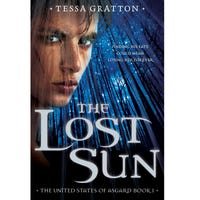
The Lost Sun

The Lost Sun
(Image from usatoday)
Tessa Gratton

In a world where the Norse Gods are real, it usually pays to be a beserker. Unless, of course, you're Soren Bearskin, son of a previously acclaimed beserker that went insane and killed thirteen people and had to be shot down by a SWAT team. 

His life seems to be going up when he meets Astrid Glyn, a seethkoma who's famous prophetess mother went missing. But his celebrations end when Baldur, the much-loved god of light, fails to rise. Now Soren and Astrid must find the missing god, and confront their own problems along the way.

I vaguely enjoy the summary I just wrote. Isn't it beautiful? However, beauty can't last, so onto the (extremely unorganized) review.

You know that one person you really want to like, but have these little habits that just bother you so much? This book was that person for me.

First of all, I love the plot. I could roll around in the plot all day while giggling like a maniac. A road trip to save a god? Awesome. Beserkers and prophetesses? Heaven Valhalla. Journey of self discovery? I love you.

And the plot was executed so beautifully. It was well-timed and well-written. The pacing was more beautiful than that summary I'm still fairly proud of. In fact, if that was the only way I judged this book, I would probably be shoving it in your face screaming, "READ IT READ IT READ IT!"

And the world? So fabulous. Oh so fabulous. Perhaps not the best built one (Does everything have to revolve around the gods? I mean, a lot of stuff being dedicated to them make sense, but absolutely everything?), but still amazing and great and fabulous and [adjective with a positive connotation]. This may have something to do with the fact that I'm obsessed with most mythologies and folktales, but ignore that. My bias can be ignored.

Wait, no it can't. Because I've read Prose Edda, and I know all you slip-ups and stare into your soul.

A lot of the stories referenced/mentioned in this book were changed for no apparent reason. A couple are reasonable (Freyja magically becoming the goddess of magic, when that's more of Odin's thing, makes sense because too many people with Odin as their patron would be weird). But for the most part, it wouldn't be significant if they were told correctly. For instance, Baldur is not the sun. You may think he's the sun, but he's not. Trust me. I wouldn't lie to you, I'm not a Lokiskin. Sol is the sun. Baldur is the god of light and innocence and other awesome stuff like that, but not the sun. Since the reason the book is called The Lost Sun is because Baldur is lost, its title must be changed. "Sun" has become a random noun. We may replace it with any other noun.

Okay, while that bothers me, it isn't the only mythological mistake in The Lost Paperclip.  The Fenris wolf was the brother (or sister, maybe) of Jormungand with the same parents. Loki and Angurboda. At no point did they turn into a young girl, but illusion magic does exist in all unreality, so whatever.

Jormungand was cut out of no one's stomach.

It wasn't Baldur's mother that refused to weep for him, it was random giantess lady-who-may-have-been-Loki, Thokk. No one but Baldur and Hodr was murdered in that story.

See? Pointless things that could easily be changed. The only reason I even bother mention is to a) say that The Lost Skeleton is by no means a mythology textbook, and b) to point out one of the habits of the person-book mentioned in paragraph one of the actual review.

The characters, even, no, especially Baldur-who-is-not-the-sun, were interesting and unique little ducklings. They had their own drives and personalities and while Soren was basically a steel wall of seriousness, were still extremely cool and fun to read. It makes sense that Soren is the wall he is, I guess- after all, he could potentially kill someone, and that, kiddies, is something to be serious about. Oh, fun fact: the word "beserker" comes from the words "bear skin". I SEE WHAT YOU DID THERE, AUTHOR LADY.

And yes, I enjoyed Baldur's character veddy much. I have no idea why. He was just cool.

Names came to be another of the irritating-habits-no-one-but-me-cares-about. Why did all of the names of things have to be changed? Canadia (although that explains why they're Canadians, not Canadans), Montania? Anglish and New Spain? Why do these names have to be different? Does it matter? Do you like the idea that it takes me a second or two to understand certain things? These are questions that must be answered.

In more, better news that once again only I care about, I could find a lot of queer subtext in this book. Not actual text, but I have my dreams (JUST YOU WAIT UNTIL THE NEXT REVIEW). Of course, this is me just throwing out things that I noticed, so this entire paragraph may be ignored. 

While the style was usually pretty great, the wording could get a little odd. 

Also, I've noticed that out of the 22 books I've reviewed (counting this one), 17 have been in first-person narrative. That comes up to 77%. What could this mean? More unimportant sentences when I should be reviewing. That's what it means.

The romance was decent. Maybe not the best, but definitely not gag-worthy.

More useless text (maybe I should just, like, change the text color of useless stuff to green so you know to ignore it): I've noticed that in novels with a male protagonist, the romance is a lot more touchy-touchy. They want to hug and cradle and otherwise hold their love interest. With female protagonists, it's more emotional stuff that they're concerned about. Just pointing that out.

And since romance is almost always the thing I end with, you all know it's good-bye time. The book was decent with its habits. I might read the next book if I saw it in the library or something, but wouldn't purposefully seek it out.

~Corinne

Monday, December 30, 2013

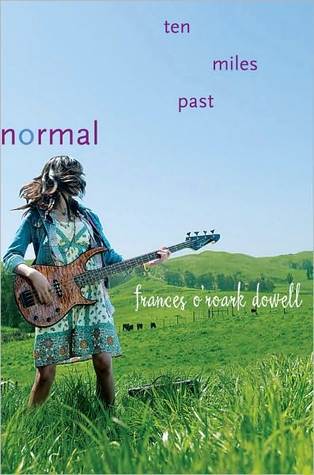
Ten Miles Past Normal

Ten Miles Past Normal
Frances O'Roark Dowell
(Image from its goodreads page)

The summary is going to be from the Amazon page. Sorry, I just couldn't figure this one out.

Janie Gorman is smart and creative and a little bit funky…but what she really wants to be is normal. Because living on an isolated farm with her modern-hippy parents is decidedly not normal, no matter how delicious the goat cheese. High school gives Janie the chance to prove to her suburban peers that she’s just like them, but before long she realizes normal is completely overrated, and pretty dull.
If she’s going to learn how to live large (and forget the haters), Janie will have to give up the quest and make room in her life for things from the fringe—like jam band, righteous chocolate, small acts of great bravery, and a boy named Monster.
Woo hoo. Thank you, Amazon, for providing me a way to be lazy. And while we're here, a shout out to my computer, for reminding me that I have no excuse not to write a review. A thank you to you both.
Okay, onto the actual part.
I loved Janie's character and voice. She was a really easy to relate to (someone tell me why "relatable" isn't a word, it would make my job SO much easier), regardless of whether or not you live on a Mini-Farm. She has a tendency to rail about her past self (who was very young and enthusiastic) and parents, but not as much complaining as a reviewer in a bad mood. As we should respect reviewers in bad moods, the amount of venting was also worthy of respect. It was just at the point of "Oh, yeah, I totally understand, literary character who cannot hear me speaking". I'm making this sound odd, but I'm sure you'd like it, reader who cannot hear me speaking.

But, as always, I must point something out that only vaguely has to do with the book. While I don't blame the author, Janie's character is the kind of character I see all the time in YA books with female protagonists. Tom-boyish, sarcastic, brown hair.

Ignore that last part.

Or don't.

Either way, I'm getting kind of tired of the generic "Sassy and Independent Barbie! (Boyfriend Included!)". It's like the be a "good character", the MC has to be masculine or, at best, gender-neutral. Anything that could even be considered feminine (the color pink, dresses/skirts, purses, make-up) is automatically shunned, deemed something for "cake-faced idiots that only know how flirt". Seriously? Can you not? Somewhere out there, someone is agreeing with me. I'm sure.

Ah, a lovely tangent we had there. Okay. Let me continue.

The supporting/secondary characters were well-written, too. Ms. Dowell either did a lot of developing outside of the story for them (the book wasn't particularly long, so most characters only had a day in the limelight), or had a great method of covering up that fact that she has no idea about these people at all.

Sarah, out of all the non-main characters, was my favorite. She had a kind of popular-girl dynamic, but without the automatic hatred you are supposed to gain upon hearing her name. In fact, I didn't feel a grand hatred of her at all. She was 100% unloathable. A wreath of flowers and a maple doughnut bar to you, author lady.
The plot itself was hard to follow, assuming there was an actual A to B plot at all. For the most part, it was a bunch of events strung together to make a story. It's... I'm noticing that a lot now. I mean, Wintergirls, Out of the Easy... What does this mean? Why are there so many "snippets of life" stories? Do they deserve a name yet? 

We'll assume that it's on of those, which I shall now call a SOL book. In which a case, this was a very good one. It even tricked me into thinking there was a plot, the sneaky little thing. However, if there was some kind SOLless plot I'm missing, it didn't do too great.
The emotions, I am so very glad, were realistic. It was easy to get lost in the going-ons of Janie's life. 
Sadly, I must now pick out the one thing that irritated me.  If I didn't, this would be "senseless praise", not a review.

The plot points, while I loved (almost) all of them, didn't get much attention of their own. They only really got short moments in the sun, and were kind of episodic. Personally, I think that either they all should have had a little more time spent on them, or some of them should have been dropped. There were just way too many things going on for any individual part to really get interesting. 

And the main one I must prey on was the romance. Oh, don't you gasp, you saw it coming from a thousand miles away. 

While the Love Interest (Monster) was interesting as a character and friend, that's what he did best as. An interesting character and an awesome friend. The romantic aspect was just taking time away from the other parts.

Trust me, the "other parts" I keep referring to vaguely, are pretty cool. Civil rights, hootenannies (Oh, so hootenanny is a word, but relatable isn't. Come on.), a vendetta against chocolate, crime-fighting goats? Well, not the last part, but you get my point.

Overall, pretty good book, would recommend it, thank you and good night.

~Corinne

Thursday, December 26, 2013

Charities

A tad belated, but, eh. For the giving spirit and because giving money is easier than trying to find a present for people.

http://www.waterforsouthsudan.org/ - I mentioned this in a review (A Long Walk to Water). The website explains itself.

http://www.roomtoread.org/  - Yay for reading! Also, this kind of tea donates a dollar to it when you buy it. So you can give the gift of tea, too.

Build Africa - No one cares that you hate school. It's still necessary.

Hurricane Haiyan - Not an actual charity, but it gives a list of reputable charities to pick from.

Red Cross - All around goodness.

Heifer International -  Because giving goats to people for their livelihood is a lot better that giving socks to people you don't like enough to actually find a good present for.

http://en.wikipedia.org/wiki/Category:Anti-bullying_charities - Okay, actually, we kinda care if you hate school. For reasons other than just because it's boring.

The Humane Society - Aminals! Animals! Whatever.

Ally Cat Allies - More cats? Less cats. No. Good cats.

Public Benefit - Another list of charities, this one for public benefit.

Book- Teen's Guide to Global Action - Not a charity, but...


Saturday, December 14, 2013

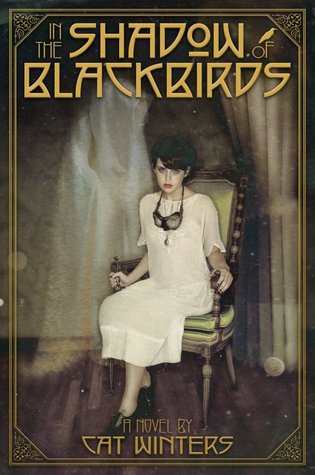
In the Shadow of Blackbirds

In the Shadow of Blackbirds
(Image from its goodreads page)
Cat Winters

It's 1918, and death hangs in the air. Influenza and war have ravaged not only Europe, but the hearts of the American people. When Mary Shelley Black finds out her first love, Stephen, has died, she's grief-stricken. But when his spirit returns to her, she's determined to learn more about what happened to him.

Okay, I'm not huge on historicals (you may notice that they're an endangered species here), and I rarely get through them. This is definitely one of the better ones.

It took a while to get into this book. Nothing particularly interesting happens for the first two, three chapters or so. So I was just kinda sitting there like, "It'll get better. It'll get better. Going sooooo sloooowwww, but it'll get- HURRY UP." I am an impatient person. This took me two check-out sessions from the library to get through it, just because the beginning didn't pass quick enough.

But it's like a slingshot. Cat Winters pulled it back ever so slowly, took target (your very being), and let go. Once Stephen died (it's not that big of a spoiler, get over it), it was off. And Mary Shelley the rock was speeding ahead at speeds I didn't think rocks could reach. And I enjoyed that.

The plot was faaaaabulous. It was well executed (trust me, there are so many bad ways to write a murder/ghost book) and once we reached that flying point, well timed. 

The style was awesome. You have no idea (or maybe you do- maybe you spy on nerds and are freakishly obsessed about what they read) how many ghost or otherwise paranormal books are purple. Like, 'Okay, I see we know how to use our descriptors here. But what are you talking about?' I am so glad this book defied my expectations.

The characters, however, I wasn't so fond of. Most of them were fairly two-dimensional. Their actions got predictable once you found out their main characteristic. And it's never good when characters have a main characteristic. People don't usually have one personality trait that defines their existence. And I can tell you those traits right now.

Mary- She's smart. Really smart. Super smart. She does smart things. Smartly. And she's brave. Like Harry Potter if he was a Ravenclaw. Because then he would be smart.

Aunt Eva- She's superstitious and protective. She's protective because she's superstitious. Or maybe not. We'll never know.

Julius- He's creepy and no one loves him.

Stephen- He's brave and hot. Oh, and smart. I guess.

Well, that's not the entire cast, but you know. Now, I didn't mind that Mary was smart and could, thank the gods of Asgard and Vaniheim, do stuff by herself. She didn't need Stephen to give her step-by-step instructions to get the job done. She is the girl, in concept, that I have been waiting for for SO LONG. But it the whole intelligence/bravery combo thing was kind of shoved in your face. And there didn't need to be (SPOILER SPOILER SKIP THE REST OF THE PARAGRAPH OR YOU SHALL DIE AT THE FIREY HANDS OF THE GODS) so much dying for her. The briefly-got-the-flu-and-survived thing was just a little much.

La, the emotions in this book. They were so deliciously well written. And there were a lot of them- you can't write about death and not have them. HAIL TO THE CAT OF WINTERS.

A good debut novel, I expect more from her soon. :D

~Corinne

Sunday, December 8, 2013

A Long Walk to Water

A Long Walk to Water
(Image from The Beachwood Reporter)
Linda Sue Park
I'm having trouble trying to summarize the book, so here's the summary from Goodreads:

The New York Times bestseller A Long Walk to Water begins as two stories, told in alternating sections, about two eleven-year-olds in Sudan, a girl in 2008 and a boy in 1985. The girl, Nya, is fetching water from a pond that is two hours’ walk from her home: she makes two trips to the pond every day. The boy, Salva, becomes one of the "lost boys" of Sudan, refugees who cover the African continent on foot as they search for their families and for a safe place to stay. Enduring every hardship from loneliness to attack by armed rebels to contact with killer lions and crocodiles, Salva is a survivor, and his story goes on to intersect with Nya’s in an astonishing and moving way.

Thank you, Goodreads, for solving almost all of my literary troubles. 

I just finished this book this morning, and since I have to compare all YA books with younger-age characters to Diamond Willow, I must say that this is a Diamond Willow. You do not have to be an eleven-year-old to enjoy this book. But you can be. Or maybe not. Who cares? Despite having two protagonists that are eleven for almost all of the book (SPOILER ALERT: Salva actually isn't eleven for all of it, though), it was pretty non-age specific.

The writing style wasn't my usual kind of read, but it still did it's (amazing) job of pulling me into the life of the characters.

The pacing was flawless, and so were the characters. I just wish that we would have heard a little bit more from Nya. I feel like the little snippets about her at the beginning of the chapter could have been just a little longer. 

Just saying, bring a box of tissues for reading. This book can and will make you cry. Sometimes, it's hard to realize that not everyone has running water and a computer to type reviews on while sipping tea. And the realization is hard. But knowing is better than any kind blissful ignorance. You can't try to help if you don't know.

And, ah, there were so many quotable lines in this book. In 112 pages, it had more memorable lines and moments than in most 400 page novels. Alas, I could not highlight anything because it's a library book. 

Okay, I'm sorry that this review was so freakishly short. I mean, five paragraphs of actual review. Very, very short paragraphs, too. Frankly, since this book is based on the childhood of someone (Salva Dut), I feel kind of odd reviewing it. Like, I'm reviewing parts of someone's life. And it was impossible to tell which parts were fact and which were fiction except for Nya's parts. Or even if Salva's narrative was fiction at all.


Interesting fact: This is why I didn't review The Queen of Water by Laura Resau and Maria Virginia Farinango (my computer doesn't allow me-to my knowledge- to make the accent mark in Maria, so sorry for that). That was an awesome book, too. Why did I review this one, then? The world may never know.

Also, this is Dut's organization that builds wells in Sudan- http://www.waterforsouthsudan.org/

So you know. :3

~Corinne